
Have you ever had a reaction that surprised even you?
Someone says something relatively innocent and suddenly you’re angry.
A friend doesn’t return a call and you immediately wonder what you’ve done wrong.
You’re offered an opportunity you’ve wanted for years, yet instead of excitement, something inside whispers, You’re not ready for this.
Or perhaps you’ve spent much of your life trying to prove that you’re good enough without ever asking yourself why you believed you weren’t in the first place.
Sometimes what we’re reacting to isn’t only what’s happening today.
We’re reacting to what today has touched.
I’ve seen this repeatedly in my work—and in my own life.
Underneath many of our reactions are emotions that were never completely understood or resolved. They can quietly influence our relationships, decisions, health, confidence, and even what we believe is possible for us.
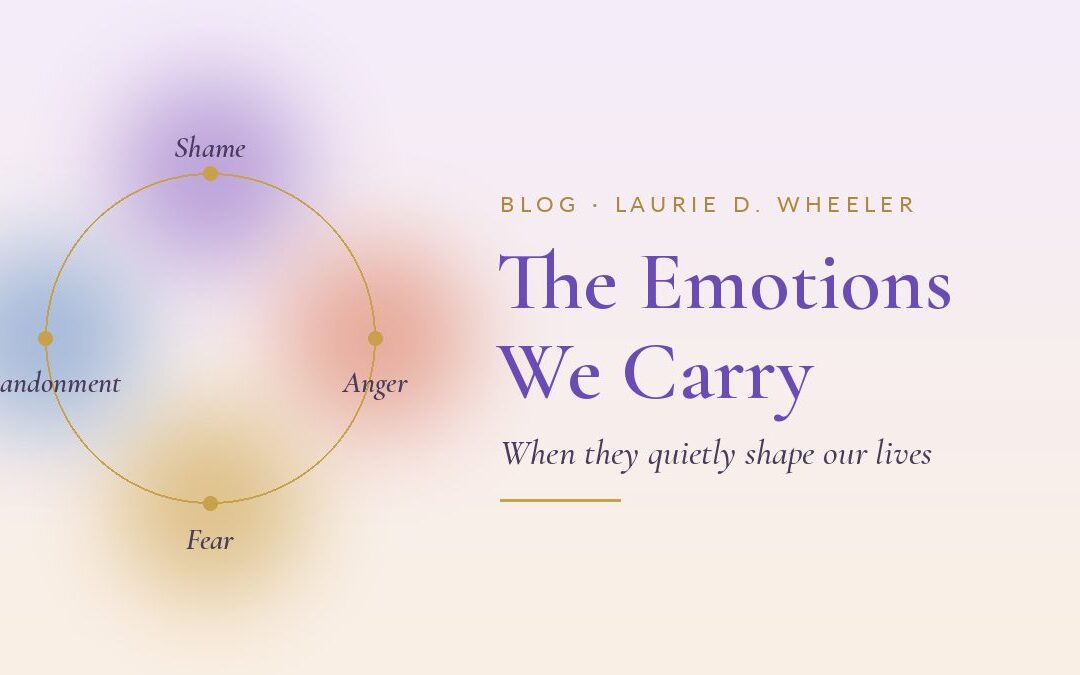
Four seem to appear again and again:
Shame. Anger. Abandonment. Fear.
They are very different emotions, but they have something important in common.
Often they are what’s making choices for us.
Shame: “Something Is Wrong With Me”
There’s an important difference between thinking I did something wrong and believing there is something wrong with me.
That’s the territory of shame.
Shame can develop through criticism, humiliation, rejection, comparison, family dynamics, or experiences in which we learned that some part of ourselves wasn’t acceptable.
And it doesn’t always announce itself as shame, but shows up like perfectionism. Does this sound familiar?
Overachieving.
Difficulty receiving compliments.
Constantly apologizing.
Hiding parts of ourselves.
Or that persistent voice asking, Who do you think you are?
Because I have always been intuitive and I listen, my mom would say “What makes you think you know?” And I would then feel shameful and want to hide this capability.
The interesting thing about shame is that we can spend years trying to become “enough” without ever questioning the original premise.
What if there was never anything you needed to prove?
Sometimes healing begins by recognizing that the voice telling us we’re inadequate may not actually belong to who we are today.
Anger: “Something Has Been Crossed”
Anger gets a bad reputation.
We’re often taught to control it, suppress it, or feel guilty for experiencing it.
But anger contains information.
Sometimes anger says:
Enough.
A boundary has been crossed.
Something feels unjust.
You’ve given too much.
You’ve remained silent too long.
Or you’ve surrendered your power to a situation you believe you cannot change.
I’ve certainly experienced this one.
I remember a time in Sedona when my anger kept building during an excursion that simply didn’t feel right. I had sensed something was off from the beginning, but I ignored that inner knowing and went along with it. Finally, exhausted and frustrated, I sat beneath a tree and heard a clear inner message: “Are you going to let him take your power?”
That stopped me. I realized my anger wasn’t necessarily the problem—it was trying to get my attention. I felt powerless because I believed I had to continue, when in fact, I had a choice. The moment I recognized that, the anger no longer needed to control me. I stood up, made my decision, and walked away.
Sometimes anger isn’t asking us to fight. Sometimes it’s asking us to recognize where we’ve given away our power—and then the opportunity to choose differently is what really matters.
Unexamined anger can become resentment, blame, aggression, or a reaction completely disproportionate to the present situation.
But conscious anger can reveal where change is needed.
Instead of asking only, Why am I so angry?
Try asking:
What is my anger trying to show me?
That’s a very different conversation.
Abandonment: “Will You Leave Me?”
Abandonment isn’t always about someone physically leaving.
We can feel abandoned when someone becomes emotionally unavailable.
When we’re overlooked or betrayed.
When someone we depend upon doesn’t show up.
And sometimes the deepest abandonment occurs when we learn to abandon ourselves to keep someone else.
We say yes when we mean no.
We silence ourselves to avoid conflict.
We become who someone else needs us to be because losing ourselves feels safer than losing them.
I came face-to-face with abandonment when I made the difficult decision to ask my first husband for a divorce after 21 years of marriage. I knew my children wouldn’t be happy. I knew other people might not understand. And perhaps hardest of all, I knew I would have to face being on my own—something I didn’t want and was deeply afraid of.
There was no choice that was going to make everyone happy, including me. But I eventually had to recognize that staying simply because I was afraid of being alone meant abandoning something else: myself. Sometimes the fear of abandonment isn’t only about someone leaving us. Sometimes it’s about having the courage not to leave ourselves behind.
As I’ve mentioned in my experience, old abandonment experiences can quietly enter present-day relationships.
A delayed text suddenly feels significant.
Distance feels like rejection.
Disagreement feels like impending loss.
We may cling—or do the opposite and leave first so no one has the opportunity to leave us.
The present situation may be real.
But the intensity of our reaction can sometimes tell us that something older has been touched.
That’s an important distinction.
Fear: “What If I’m Not Safe?”
Fear is essential – it helps protect us.
But our internal alarm system doesn’t always distinguish perfectly between something dangerous now and something that reminds us of danger from before.
That’s why fear can sometimes appear even when our logical mind says, There’s nothing to be afraid of.
Fear of failure.
Fear of illness.
Fear of being seen.
Fear of succeeding.
Fear of making the wrong decision.
Fear of what other people will think.
Fear of the unknown.
I once had a vivid experience during a deep meditation. I saw two young women driving in a car, and then an accident. It frightened me. I didn’t want to see where it was going or know anything more, so I consciously shut the experience down.
Not long afterward, my daughter was in a car accident and rushed to the hospital. I couldn’t help but think back to what I had seen. Whether we call experiences like this intuition, inner knowing, or something we don’t completely understand, it taught me something important about fear: fear can make us close the door before we’ve had the opportunity to listen. I’ve since learned that discernment isn’t about accepting everything we sense as fact. It’s about remaining present long enough to ask, What am I experiencing, and is there something here I need to pay attention to?
I’ve learned not to automatically ask fear to disappear.
Instead, I’ve become more curious about it.
Is there something here I genuinely need to pay attention to—or is an old experience trying to protect me from something that is no longer happening?
That question creates space between the feeling and the decision.
And inside that space is choice.
Your Brain Takes Emotional Pain Seriously
There’s an interesting reason these experiences can feel so powerful.
Research by UCLA psychologist Naomi Eisenberger and colleagues found that social rejection engages some of the same neural systems involved in the distressing component of physical pain.
Think about our language:
That broke my heart.
Her words really hurt.
I felt crushed.
Our language may be more accurate than we realize.
Another line of research by UCLA psychologist Matthew Lieberman and colleagues found something equally interesting: simply putting feelings into words—known as affect labeling—was associated with reduced amygdala activity and increased activity in a region of the prefrontal cortex involved in regulation.
In very simple terms:
Naming what we’re feeling can begin changing our relationship to it.
That’s why awareness matters so much.
What’s Really Driving the Reaction?
Imagine someone makes a comment and you immediately become defensive.
Before reacting, you pause.
What am I actually feeling?
Anger?
Go underneath it.
Maybe there’s fear.
Go underneath that.
Perhaps there’s an old experience of rejection.
And underneath that?
Maybe I’m afraid I’m not enough.
Suddenly, you’re no longer simply arguing about today’s comment.
You’ve found the string.
And now you can ask:
Does this belong to what is happening right now—or is something from my past participating in this moment?
That is discernment.
And I believe it’s one of the most important skills we can develop.
Awareness Doesn’t Mean Blame
Looking backward isn’t about blaming our parents, partners, childhoods, or circumstances for who we are today.
Nor does every difficult emotion need to be “healed away.”
Anger, fear, shame, and feelings of abandonment are part of being human.
The goal isn’t to become emotionless.
The goal is to stop allowing an unrecognized emotion to unconsciously run our lives.
We can notice it.
Name it.
Become curious about where it originated.
Listen to what it’s trying to communicate.
And then decide whether it still deserves a vote in what happens next. And this is important….
That’s where our power returns.
So sometime this week, if you have a reaction that feels particularly strong, don’t immediately judge it or push it away – because you would have in the past.
Pause for a moment and ask:
What did this just touch in me?
You may discover that the argument isn’t really about the argument.
The fear isn’t entirely about today.
The anger has something important to tell you.
Or the person you’re afraid will abandon you isn’t the person you’ve been abandoning at all.
Perhaps it’s yourself.
And once we can see what has been quietly operating beneath the surface, we have something we didn’t have before:
Choice.
And choice is where change begins.
Five Ways to Work with the Four Wounds
1. Name It to Tame It
The next time a strong emotion hits, pause and label it. Out loud or silently. “This is shame.” “This is fear.” Be specific. Putting a feeling into words calms the amygdala and hands the wheel back to your thinking brain.
2. Trace the String
When a reaction feels bigger than the moment deserves, ask yourself: “Which wound is this? Shame, fear, anger or abandonment?” You don’t have to fix anything yet. Just tracing the reaction back to its source loosens its grip.
3. Put It on Paper
Spend five minutes writing about a moment when one of the four wounds showed up this week. What triggered it? What did it feel like in your body? Research on expressive writing shows that translating emotional experiences into written words delivers real mental and physical health benefits.
4. Breathe Your Way to Safety
Fear’s antidote is a felt sense of safety, and the fastest way to signal safety to your nervous system is through your breath. Empty your lungs, inhale slowly for a count of four, hold for a moment, then blow it all out through your mouth. One intentional breath tells your brain: no danger here.
5. Meditate on It
Awareness is a muscle, and meditation is how you train it. A regular practice makes it easier to catch a wound in the act. To see the string before it pulls you.
Ready to go deeper? Laurie’s guided meditations, including I AM Enough, Heal Abandonment, Return to Yourself and Anxiety, Uncertainty & Finding the Next Step, were created to help you work with these emotions. Explore the meditations in the store.